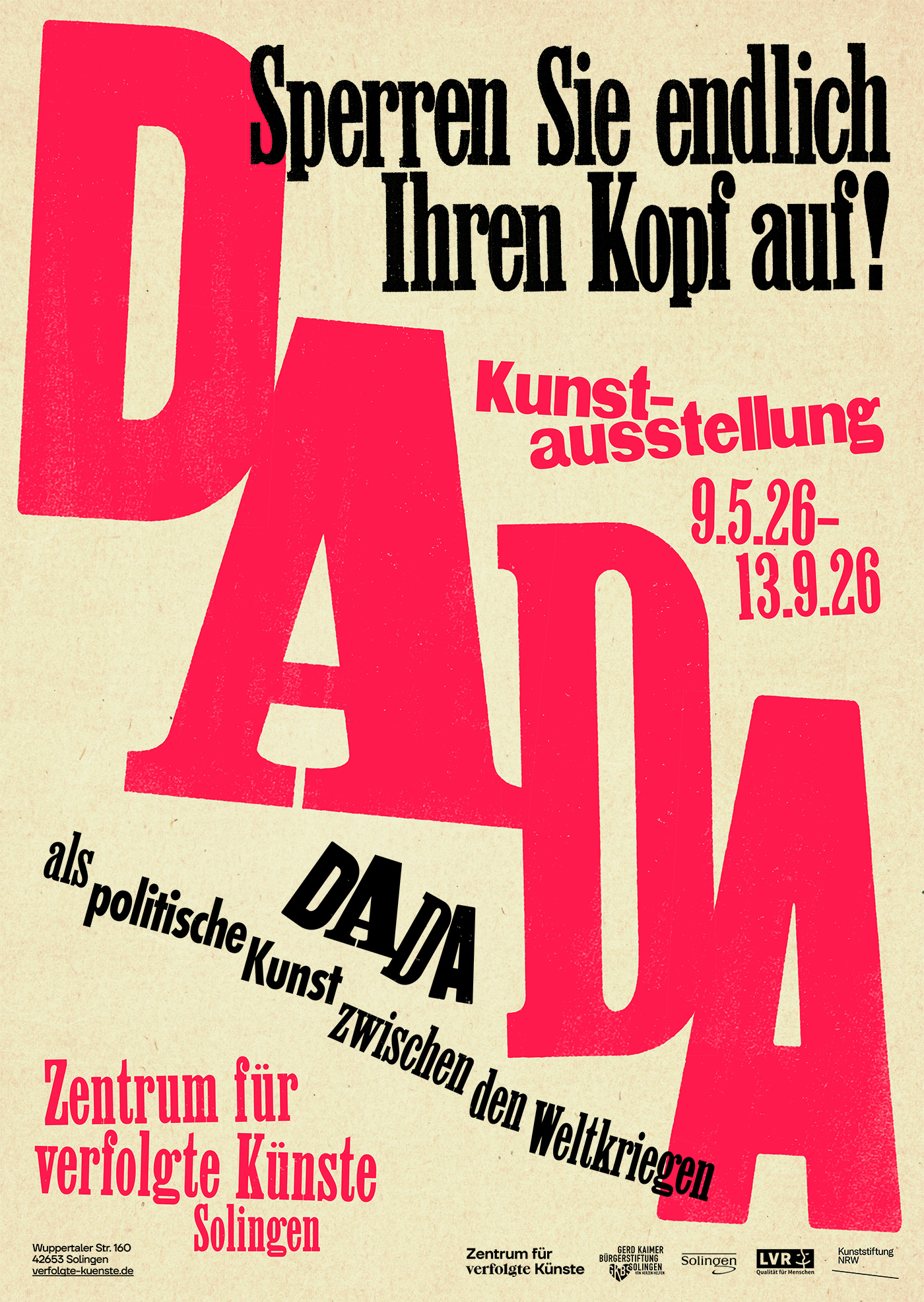
May 9 - September 13, 2026
Center for Persecuted Arts
Wuppertaler Strasse 160, 42653 Solingen
Dare to be more dissenting: Exhibition in Solingen calls for “more Dada”
In a time when wars, authoritarian thinking, political brutality, and attacks on language and truth are on the rise again, Dada is more relevant than ever. The Center for Persecuted Arts is therefore deliberately making a statement: Today we need more Dada—more dissent, more intellectual unrest, more courage to disrupt apparent certainties.
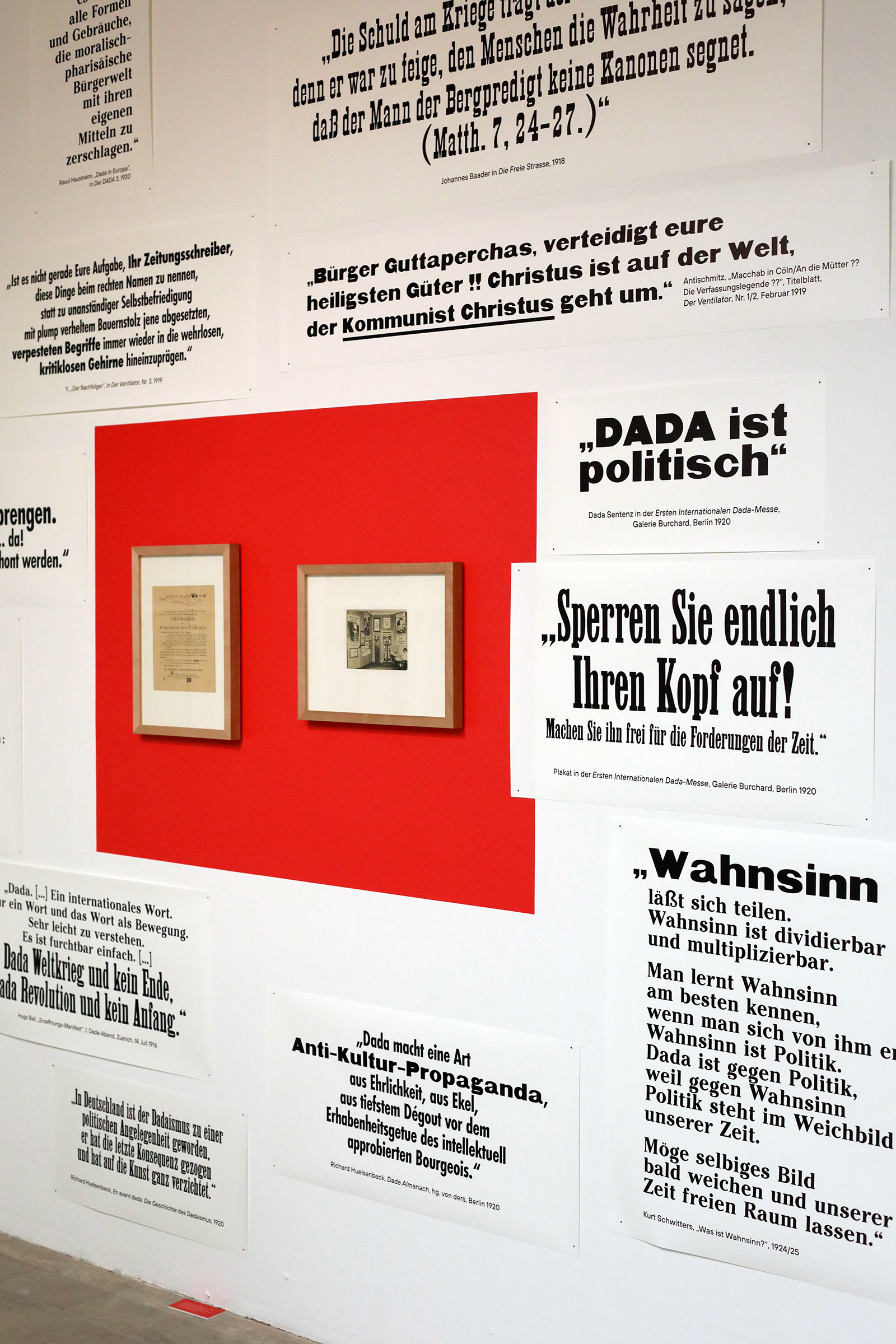
“Take Dada seriously!”
On Dada’s 110th anniversary, we celebrate the courage of the artists who used their work to advocate for a better society! Exemplary. Back then, Dada, as a reaction to the First World War, resisted the harmful socio-political dynamics that had allowed it to happen and that now prevented genuine progress in the new Weimar Republic. What do we do today?
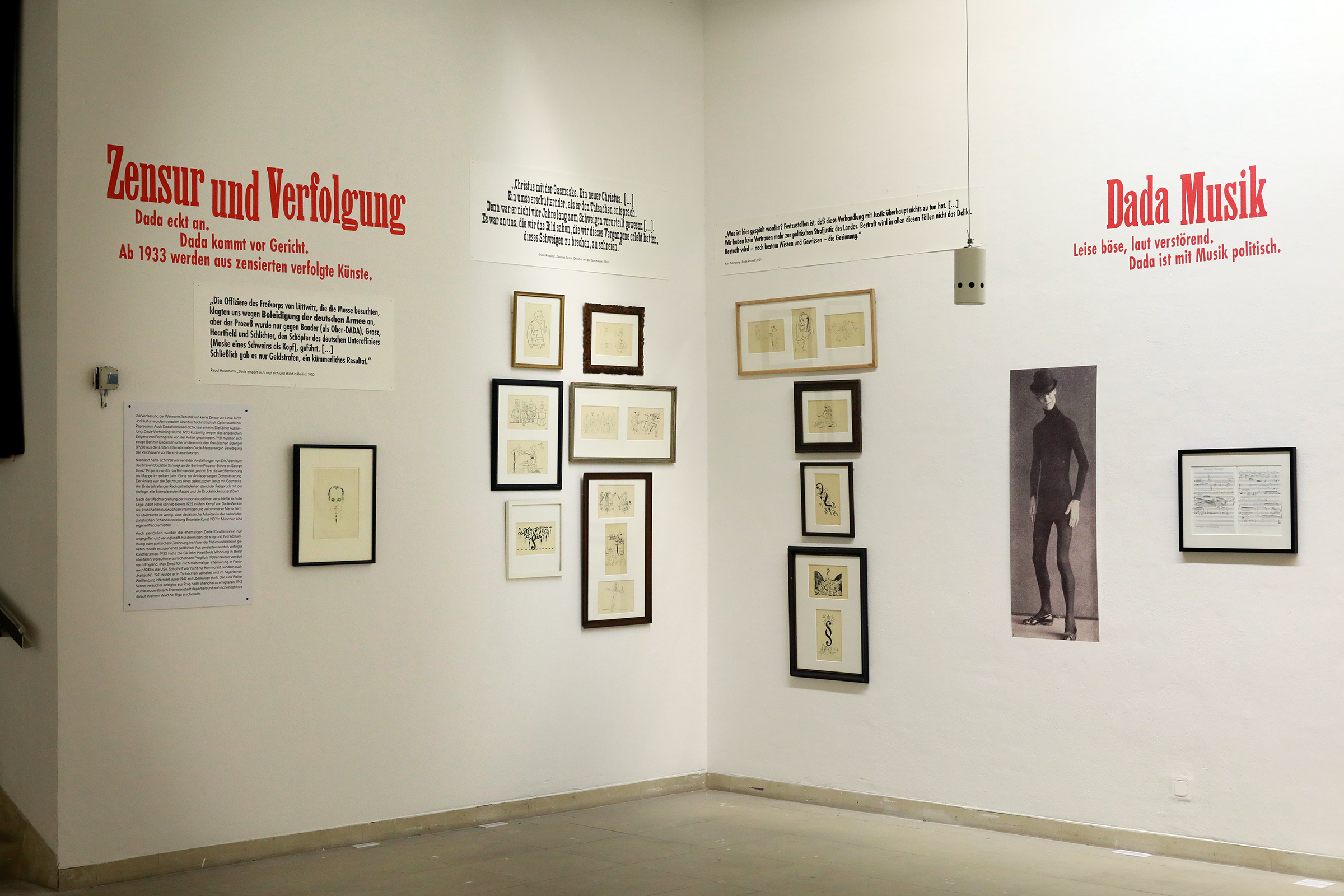
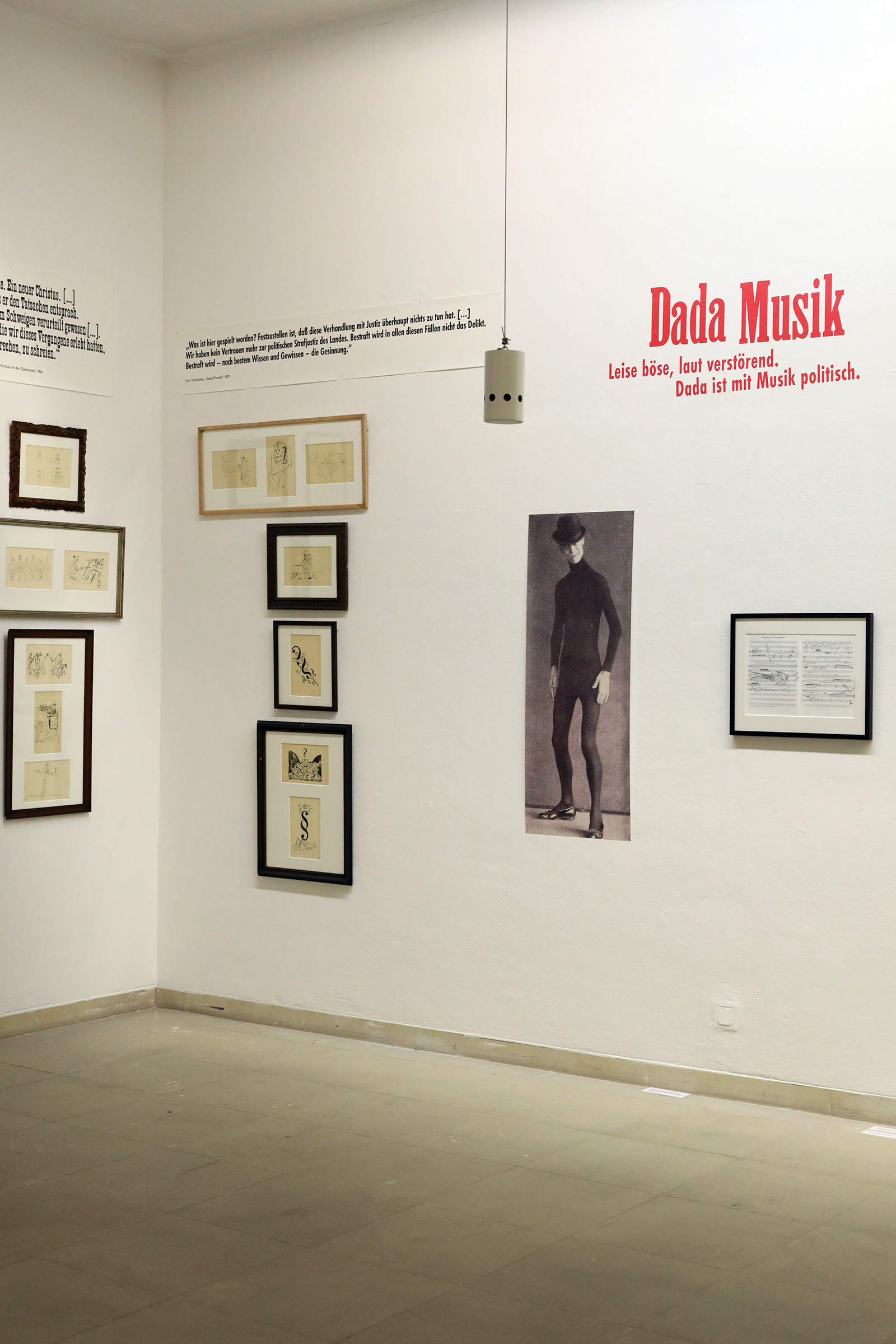
Anti-bourgeois, anarchist, and pacifist, Dada, with its sharp eye and biting satire, offered social criticism, questioning established values and political and social conditions. Founded in 1916 during the war, the movement's end is generally placed in the early 1920s. However, artists like George Grosz, Hannah Höch, and John Heartfield later used art to fight against the rising National Socialism. The National Socialists considered Dada "degenerate."
The art of the Dadaists is colorful, loud—and by no means uniform. They employed a wide variety of styles and produced literature, poetry, plays, paintings, prints, collages, and photographs. Yet, the political is a central common denominator, a thread running through the movement's work and expressed in diverse and unexpected ways
With works by, among others, Johannes Baader, Hugo Ball, Erwin Blumenfeld, Paul Citroën, Otto Dix, Otto Griebel, George Grosz, John Heartfield, Marta Hegemann, Emmy Hennings, Hannah Höch, Heinrich Hörle, Richard Hülsenbeck, Franz Jung, Walter Mehring, Rudolf Schlichter, Kurt Schwitters, Sophie Taeuber-Arp.
Some of the questions addressed in the exhibition remain relevant today. How does art respond to societal crises? How does freedom assert itself against ideology, oversimplification, and violence? And how can artistic strategies of rupture and disruption help us rethink democracy, the public sphere, and responsibility?
With this approach, the Center for Persecuted Arts builds upon its overarching work: It explores the conditions of visibility, exclusion, and remembrance in art history and examines which political forces determine which voices are heard and which are suppressed.
The exhibition is curated by Dr. Katharina Günther. In this exhibition, the art historian focuses on modern art and its political, social, and intellectual contexts. She combines historical precision with an exploration of the contemporary relevance of artistic positions.
“Dada is exciting, innovative art, but also a call to action. The pacifist Dadaists already questioned the purpose of the First World War. Unemployment and poverty characterized the new Weimar Republic, and the bourgeoisie was sluggish in thought and action. Power structures from the German Empire had remained in place, and a select few were lining their own pockets. Dada denounced these injustices and called upon the public to look, reflect, and understand.” — Dr. Katharina Günther
A special highlight of the program is an evening with Blixa Bargeld on Thursday, June 25, 2026. The musician and author's very name is an homage to the Cologne Dadaist Johannes Baargeld. With Einstürzende Neubauten, the singer Bargeld brought Dada into the present. In his solo projects, he continues the Dadaist tradition of linguistic and intellectual radicalism.
The musician, writer, and actor Rocko Shamoni will speak on Sunday, May 31, 2026, about Dada, nonsense, absurdity, and humor as stylistic and combative tools in art.
Both events are presented in cooperation with Ox Fanzine.
“Dada is not "over" even today. After NO!art and Fluxus, Dada survived underground and, above all, in music. Dada continues to exist in deliberate anti-sound, in playing with nonsense, in performative attacks from the litter box. Dada is a call to recognize the mechanisms of power in image, in sentence, in reflex. "Open your head" doesn't mean more information. It means finally start thinking—and acting, so that our democracy doesn't perish!” — Dr. Jürgen Joseph Kaumkötter
Accompanying program:
- Sat, May 9, 2026, 6:00 PM – Opening Reception
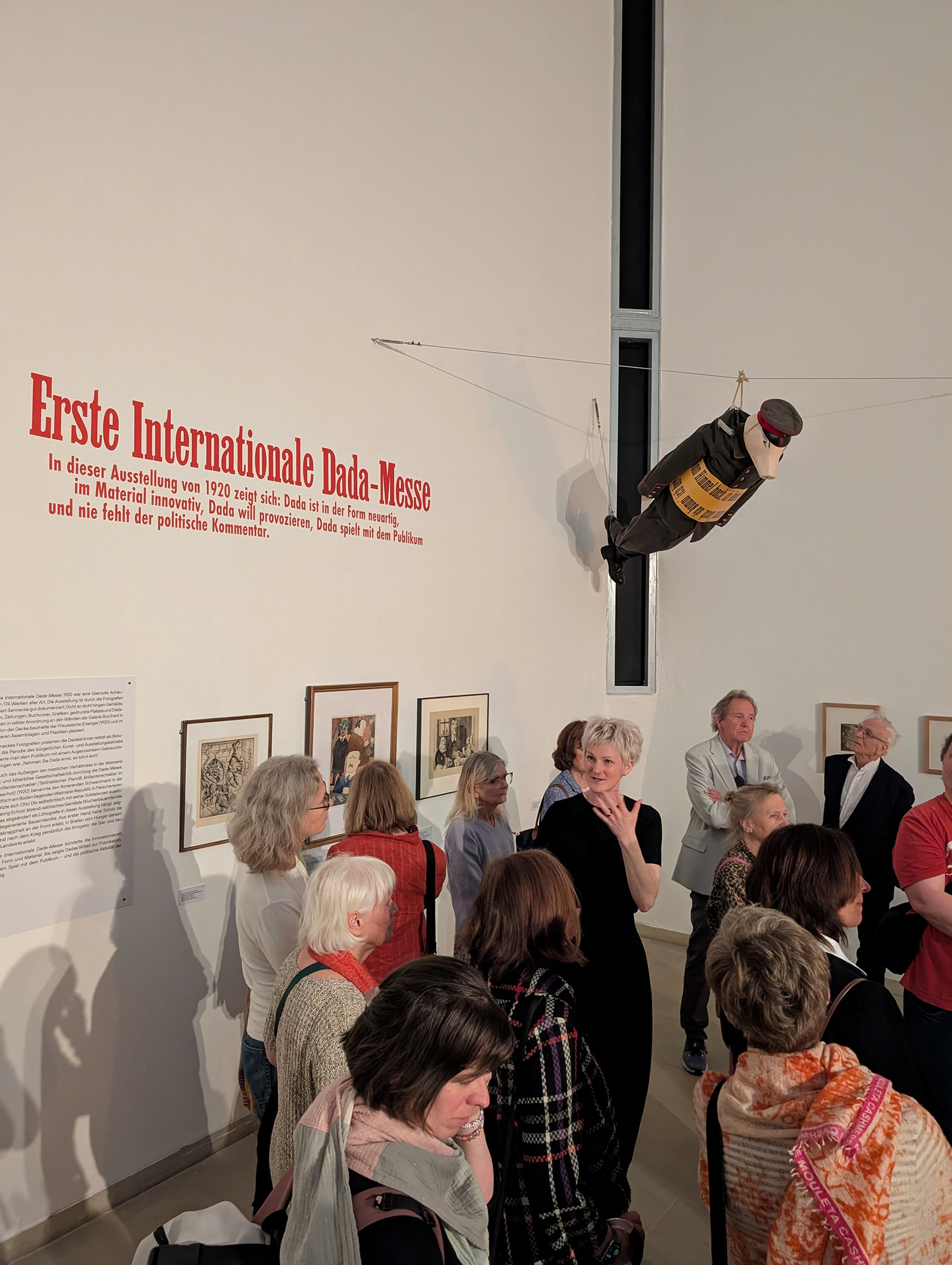
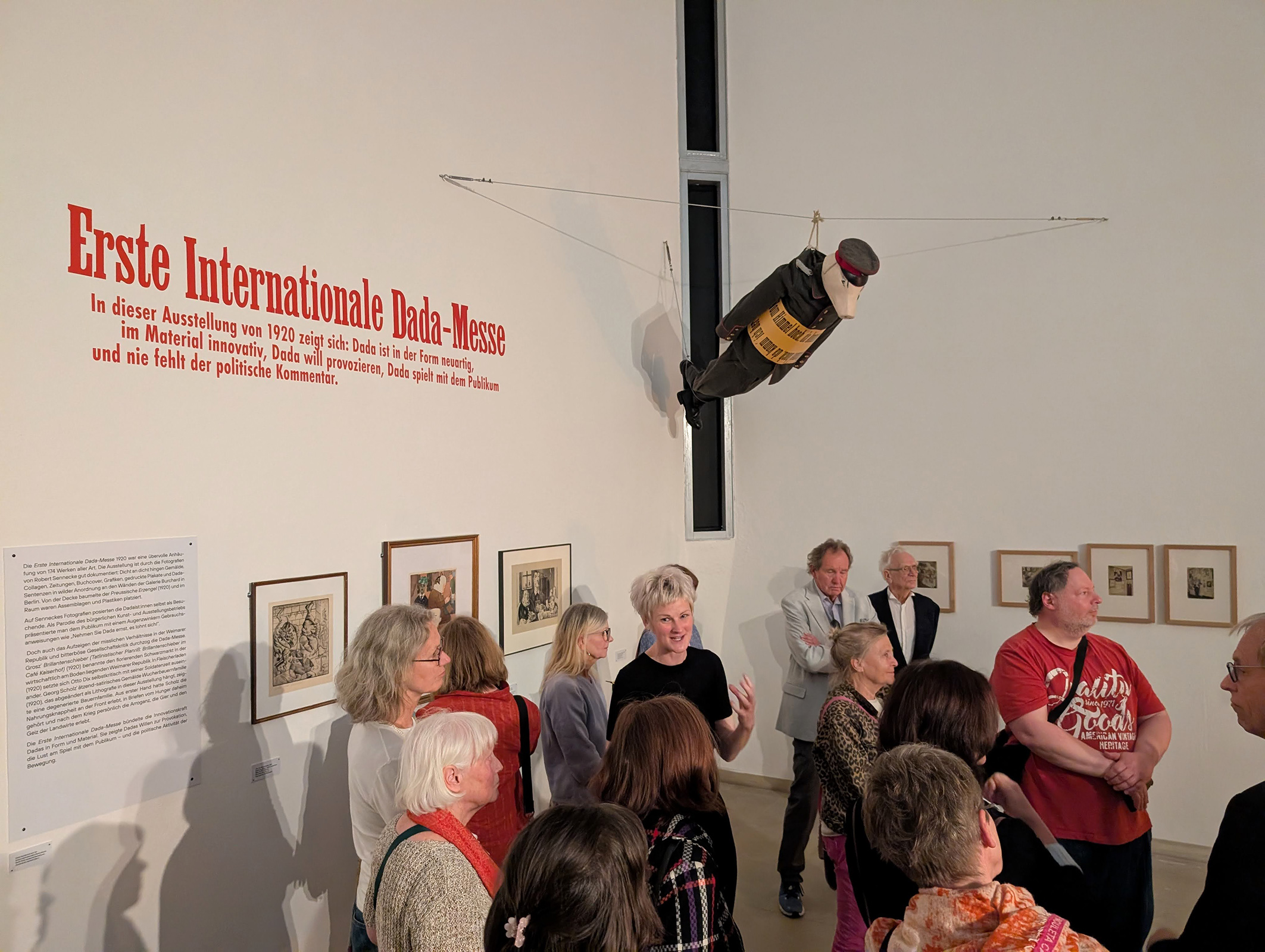
- Sun, May 10, 2026, 3:00 PM – Public Curator-Led Tour with Dr. Katharina Günther
- Sun, May 31, 2026, 5:30 PM – Rocko Schamoni in conversation about Dada, nonsense, absurdity, and humor in art
- Thu, June 25, 2026, 8:00 PM – Blixa Bargeld, solo performance
- Sun, July 5, 2026, 3:00 PM – Artist Talk with Simon Wachsmuth and Prof. Dr. Christian Berger
- Sun, September 13, 2026, 3:00 PM – Closing Reception, Guided Tour with Rosa Räderscheidt
Public tours are offered on Sundays at 3:00 PM. No prior registration is necessary. The tour is included in the admission price. The meeting point is in the foyer near the ticket counter.
Private guided tours for up to 25 people can be booked for €70.
Workshops for schools and other groups can be arranged individually.
For inquiries and to schedule a tour, please contact info@verfolgte-kuenste.de
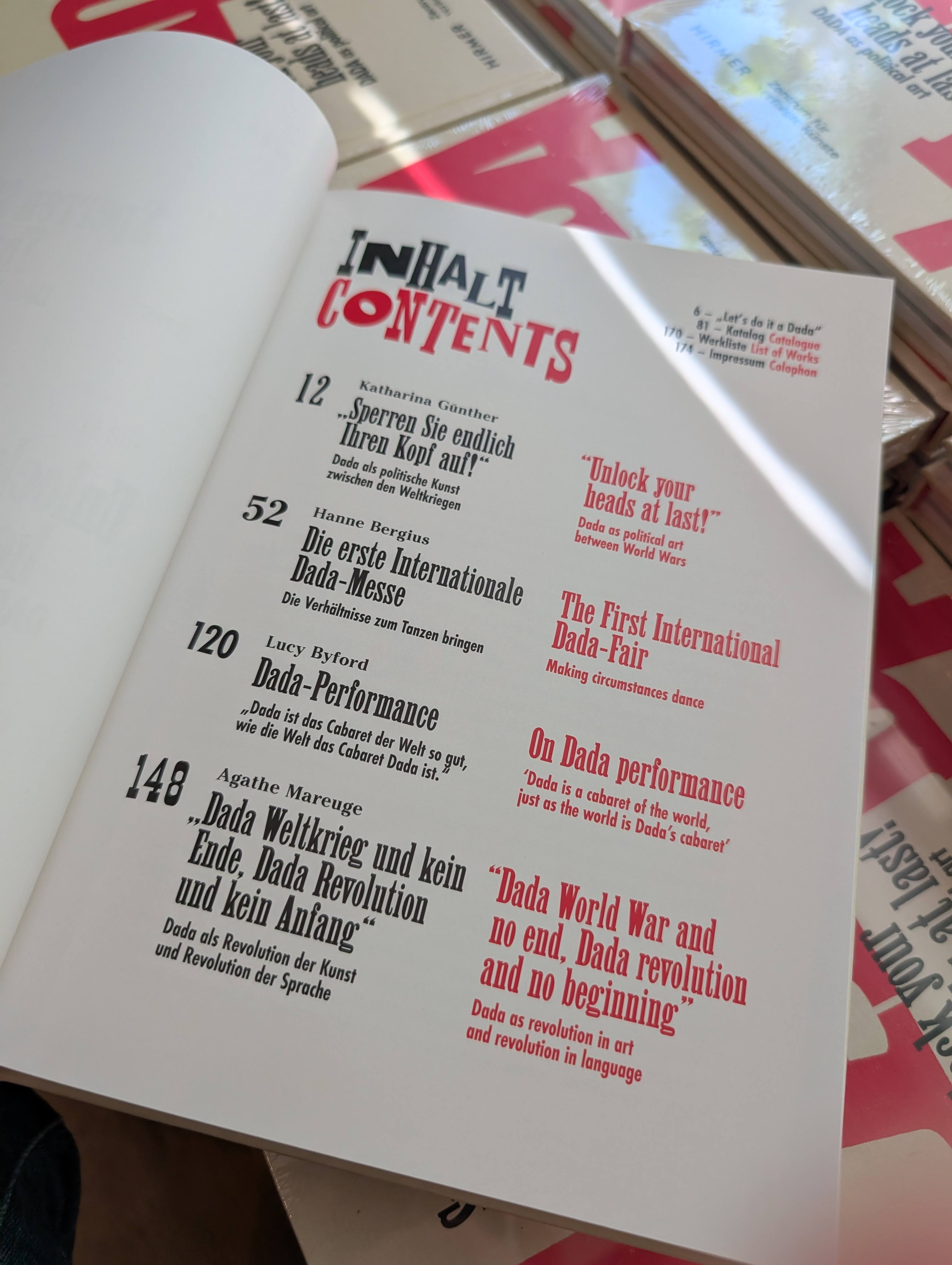
A bilingual catalog will be published by Hirmer Verlag to accompany the exhibition. It includes essays by Katharina Günther, Hanne Bergius, Lucy Byford, Agathe Mareuge, and “Let’s do it a Dada” by Jürgen Joseph Kaumkötter.
Download excerpt from the catalog with table of contents, foreword, introduction and list of works (pdf, 4.42MB)
The images listed below are in the public domain and may be used freely, provided they are accompanied by their respective captions. All other images are still subject to copyright and require separate permission from us. These may be used free of charge upon request.
Contact person
Daniela Tobias
email: presse@verfolgte-kuenste.de
The Center for Persecuted Arts in Solingen is an international museum and a renowned research center. It is the only museum dedicated exclusively to artists whose work was hindered, prevented, or destroyed by dictatorships, war, and political persecution.
Dr. Katharina Günther, art historian and curator of the Center for Persecuted Arts, studied in Cologne and Antwerp and received her doctorate from the University of Cologne. Her academic and curatorial positions have taken her to institutions including the Klassik Stiftung Weimar, the Francis Bacon MB Art Foundation in Monaco, The Estate of Francis Bacon in London, the Hugh Lane Gallery in Dublin, and the Museum of Contemporary Art Siegen. Her work combines international research with curatorial experience at prestigious institutions.
Further information: persecuted-arts.com
contact
Center for Persecuted Arts
Wuppertaler Strasse 160
42653 Solingen
info@verfolgte-kuenste.de
Tel.: 0212 23 37 47 52 (Mon-Fr, 9-12)
Opening hours
Tue—Sun, holidays 10 AM — 5 PM
Closed on Mondays
Getting there
Stop: “Gräfrath” (bus 683)
Parking: Dycker Feld
The exhibition is supported by the Gerd Kaimer Citizens' Foundation Solingen, the Kunststiftung NRW and the Regional Cultural Funding of the LVR.
The museum Center for Persecuted Arts is part of the LVR Cultural Heritage Network.



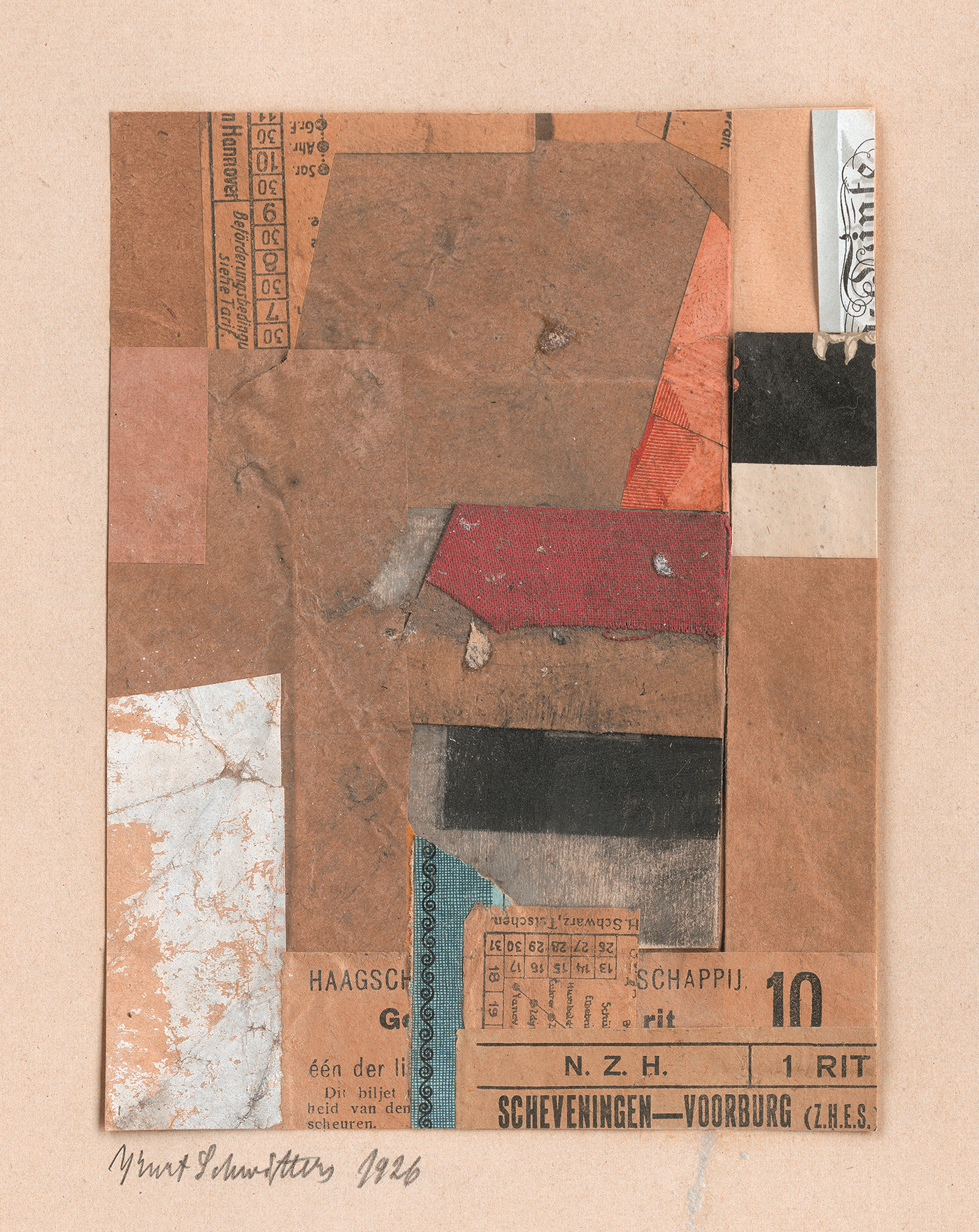
On request, we can provide you with the following images, which can be used free of charge under certain VG Bild-Kunst conditions:
- Otto Dix, match dealer, 32 x 48.5 cm, 1920, etching on paper, Gera Art Collection — Niescher Collection/© VG Bild-Kunst, Bonn 2026
- George Grosz, The Menace, 1934, watercolor on paper, 61 x 44.5 cm, Judin Collection, Berlin © Estate of George Grosz, Princeton, N.J./VG Bild-Kunst, Bonn 2026
- George Grosz, Christ with the Gas Mask, plate 10 of 17 drawings for the performance of “Sweden”, 17 x 26.5 cm, Berlin 1928, Wassermeyer Collection © Estate of George Grosz, Princeton, N.J./VG Bild-Kunst, Bonn 2026








.jpg)