On February 9, 2024, a memorable exhibition building was opened on the grounds of the International Youth Meeting Center in Oświęcim. “Gerhard Richter. Birkenau” is visible from the busy Legionów Street in large stainless steel letters next to the door. Two kilometers away, along the Soła River, is the former Auschwitz I concentration camp. After Birkenau, it is another three kilometers away.
The director of the museum Center for Persecuted Arts, Dr. Jürgen Joseph Kaumkötter, was invited to the opening. Delfina Jałowik, long-standing cooperation partner of the center on various projects, in February still curator at MOCAK Museum of Contemporary Art Krakow and since March 1, director of Bunkier Sztuki in Krakow, conducted an interview with Sabine Moritz-Richter, the wife of Gerhard Richter, on the day of the opening. The 23-minute interview is here on YouTube to see.

Some regard the group of works as a late highlight in Gerhard Richter's work, as a result of his many years of exploration of the possibilities and limits of painting in terms of depicting historical trauma. For others, it represents a presumptuous transgression. This debate has been going on ever since the four paintings received the title “Birkenau.” But how did this come about? The origin of the “Birkenau” series lies in Richter's examination of four photographs of Auschwitz prisoner Alberto Errera, which Richter became aware of in a book review in the Frankfurter Allgemeine Zeitung about Georges Didi-Huberman's book “Pictures Despite Everything.”

Alberto Errera, together with other Greek Jews, was captured by German soldiers in Larisa, Greece in March 1944 and deported to the Auschwitz-Birkenau concentration camp on April 11, 1944. There, Errera was forced to work as a member of the Sonderkommando in Crematorium V. He allegedly played a role in planning a prisoner uprising and probably took just the four photos in the courtyard of Crematorium V that could be smuggled out of the camp. Errera's life ended when he tried to escape when he allegedly tried to cross the Soła River and was shot dead.
Gerhard Richter first painted Errera's Auschwitz photos as monumental large formats. “There are simply some photos that become bad paintings when you copy them,” Richter said. Not satisfied with the initial result, he used another technique known and common to him. He painted over the original paintings. Scraped off the paint, repainted it, took the squeegee and slider, smudged the still damp paint, scraped it off again and finally the new layers of gray, green and red paint covered everything up.
The paintings were initially called “abstract pictures” in Dresden Albertinum exhibited in the “New Presentation” exhibition. Nothing pointed to the context. In February 2016, they were given the name and the series was released under the title “Birkenau” in Frieder Burda Museum shown in Baden-Baden, supplemented by photographs from Richter's collection on the subject of Nazi terror. In 2016 and 2017, the paintings were on display at the Jewish Museum and Tolerance Center in Moscow, followed by exhibitions in Prague and at Queensland Art Gallery in Brisbane. The “Birkenau” series was presented in 2020 in the exhibition “Gerhard Richter: Painting After All” at Met Breuer New York shown in a separate room, where large mirror panels, similar to the presentation in Dresden, closed off the room and four additional reproductions of the oil paintings were juxtaposed with the works. In the New York exhibition, the reproductions, the oil paintings and also the mirror plates were supplemented with four digitally printed photos by Alberto Errera.
The “Birkenau” series was installed on September 5, 2017 in the Reichstag in Berlin as a print on aluminum plates, opposite Richter's “Black, Red, Gold” and not next to each other, but on top of each other. All plants are part of the plants founded in 2020 Gerhard Richter Art Foundation. All works of art belong to the Foundation and are on permanent loan in public museums and institutions, including in the German Bundestag. Die Gerhard Richter Art Foundation runs the Birkenau cycle as an edition of three copies, the original oil paintings, the reproductions on aluminum Dibond plates in the German Bundestag and in Oświęcim.
Die Alte Nationalgalerie In Berlin, from March 16 to October 3, 2021, the series was shown under the theme “Reflections on Painting. Gerhard Richter's' Birkenau 'cycle”, again accompanied by reproductions of historical photographs. Starting in 2023, the originals, together with 100 other works from various periods of Richter's work, will be part of a long-term exhibition at New National Gallery shown in Berlin, which is to last until 2026 and will later move to the new Herzog & de Meuron museum building. Joachim Jäger, managing director of the National Gallery and director of the New National Gallery, said: “100 works by Gerhard Richter for Berlin — it is and remains a sensation. The 'Birkenau' cycle plays a central role. This work, which is also particularly important for Gerhard Richter himself, not only keeps the memory of the Holocaust alive, but also repeatedly raises the question of how to deal with the unprecedented crime against humanity. ”
Birkenau is a real place and a topos. Birkenau marks one of the darkest chapters in human history. The monstrosity of this place and the crime that happened there justify all superlatives, but also makes all works of art relating to this place a tightrope walk. And with this wire rope, you have to be careful with superlatives.
Theodor W. Adorno's provocation “Writing a poem after Auschwitz is barbaric,” places his finger right in this wound. Adorno wrote the sentence in 1949. Hardly any other statement about Auschwitz, the Shoah and culture has been quoted, discussed, abbreviated and evaluated so often. Adorno's statement is not the only radical one. Beyond the content, the vehemence of the debate that has continued to this day shows that Adorno has addressed something existential in relation to the topos of Auschwitz: the impossibility of making a tangible idea of something unimaginable and thus breaking the semantics of a ban on images. The artists in Auschwitz, the pictorial worlds of the prisoners, represent this ban on images. They cannot depict the inhuman reality, simply capture scenes of horror or reflect their emotionality in an internal view. After the liberation, pictures were created about the topos of Auschwitz, which failed Adorno in the most causal sense. More broadly, they fail in their visual language, in the semantics of the works of art.

In October 2021, Christoph Heubner convinced of International Auschwitz Committee Gerhard Richter, the “Birkenau” paintings of International Auschwitz Committee and to display it in a memorial room designed by the artist at the International Youth Meeting Center in Oświęcim. The exhibition hall built especially for these paintings is the size of a single-family house and is directly accessible from Legionów Street, which connects the International Youth Meeting Center with the Auschwitz-Birkenau State Museum. The planners could also have integrated the building into the many pavilions of the youth meeting center. They could have placed it in the second row and thus establish a clear connection to the youth community center. They have decided against it. The building opens onto the street.

A band of windows divides the façade of the house and becomes a skylight. On the outside, high arched windows, two actual and several indicated ones, divide the wall surface. The interior is unobtrusively simple. Grey and white dominate. Materiality becomes visible: wood, concrete, screed. Four picture plates on white walls on the right and left, the abstract images as reproductions on aluminum on the right and the reflecting plates on the left. Two photos of Errera on concrete in a grey frame and a white passe-partout on the front and back. There are four benches in the middle of the room: symmetry with an unobstructed view of the trees on the Soła dike, where Alberto Errera, the photographer, was probably shot.

Before you reach the exhibition room, two monitors and wall texts format the visit in an anteroom. In German, Polish and English, a quote from Gerhard Richter introduces us to the works of art: it is only through pictures that we become people. An assertion in superlative mode. There is something religious about it and fits in with the chapel-like nature of the room. Despite its simplicity, everything about this place is too much.
In a ZEIT article from 2016, Hanno Rautenberg criticized Gerhard Richter's “Birkenau” cycle by noting that Richter's works “captured nothing, did not express anything.” He characterized the paintings as open and invited viewers to see what they would like — a view that Marian Turski also shared in his keynote speech on February 9. The 97-year-old Auschwitz survivor and President of the International Auschwitz Committee Turski welcomed this openness of images. Rautenberg ended his deliberations with a critical assessment: Due to its apparent openness to interpretation, “Birkenau” could become what it should never be — a myth.
What’s a Rich Text element?
The rich text element allows you to create and format headings, paragraphs, blockquotes, images, and video all in one place instead of having to add and format them individually. Just double-click and easily create content.
Static and dynamic content editing
A rich text element can be used with static or dynamic content. For static content, just drop it into any page and begin editing. For dynamic content, add a rich text field to any collection and then connect a rich text element to that field in the settings panel. Voila!
How to customize formatting for each rich text
Headings, paragraphs, blockquotes, figures, images, and figure captions can all be styled after a class is added to the rich text element using the "When inside of" nested selector system.
What’s a Rich Text element?
The rich text element allows you to create and format headings, paragraphs, blockquotes, images, and video all in one place instead of having to add and format them individually. Just double-click and easily create content.
Static and dynamic content editing
A rich text element can be used with static or dynamic content. For static content, just drop it into any page and begin editing. For dynamic content, add a rich text field to any collection and then connect a rich text element to that field in the settings panel. Voila!
How to customize formatting for each rich text
Headings, paragraphs, blockquotes, figures, images, and figure captions can all be styled after a class is added to the rich text element using the "When inside of" nested selector system.
What’s a Rich Text element?
The rich text element allows you to create and format headings, paragraphs, blockquotes, images, and video all in one place instead of having to add and format them individually. Just double-click and easily create content.
Static and dynamic content editing
A rich text element can be used with static or dynamic content. For static content, just drop it into any page and begin editing. For dynamic content, add a rich text field to any collection and then connect a rich text element to that field in the settings panel. Voila!
How to customize formatting for each rich text
Headings, paragraphs, blockquotes, figures, images, and figure captions can all be styled after a class is added to the rich text element using the "When inside of" nested selector system.
What’s a Rich Text element?
The rich text element allows you to create and format headings, paragraphs, blockquotes, images, and video all in one place instead of having to add and format them individually. Just double-click and easily create content.
Static and dynamic content editing
A rich text element can be used with static or dynamic content. For static content, just drop it into any page and begin editing. For dynamic content, add a rich text field to any collection and then connect a rich text element to that field in the settings panel. Voila!
How to customize formatting for each rich text
Headings, paragraphs, blockquotes, figures, images, and figure captions can all be styled after a class is added to the rich text element using the "When inside of" nested selector system.
What’s a Rich Text element?
The rich text element allows you to create and format headings, paragraphs, blockquotes, images, and video all in one place instead of having to add and format them individually. Just double-click and easily create content.
Static and dynamic content editing
A rich text element can be used with static or dynamic content. For static content, just drop it into any page and begin editing. For dynamic content, add a rich text field to any collection and then connect a rich text element to that field in the settings panel. Voila!
How to customize formatting for each rich text
Headings, paragraphs, blockquotes, figures, images, and figure captions can all be styled after a class is added to the rich text element using the "When inside of" nested selector system.
What’s a Rich Text element?
The rich text element allows you to create and format headings, paragraphs, blockquotes, images, and video all in one place instead of having to add and format them individually. Just double-click and easily create content.
Static and dynamic content editing
A rich text element can be used with static or dynamic content. For static content, just drop it into any page and begin editing. For dynamic content, add a rich text field to any collection and then connect a rich text element to that field in the settings panel. Voila!
How to customize formatting for each rich text
Headings, paragraphs, blockquotes, figures, images, and figure captions can all be styled after a class is added to the rich text element using the "When inside of" nested selector system.
What’s a Rich Text element?
The rich text element allows you to create and format headings, paragraphs, blockquotes, images, and video all in one place instead of having to add and format them individually. Just double-click and easily create content.
Static and dynamic content editing
A rich text element can be used with static or dynamic content. For static content, just drop it into any page and begin editing. For dynamic content, add a rich text field to any collection and then connect a rich text element to that field in the settings panel. Voila!
How to customize formatting for each rich text
Headings, paragraphs, blockquotes, figures, images, and figure captions can all be styled after a class is added to the rich text element using the "When inside of" nested selector system.
What’s a Rich Text element?
The rich text element allows you to create and format headings, paragraphs, blockquotes, images, and video all in one place instead of having to add and format them individually. Just double-click and easily create content.
Static and dynamic content editing
A rich text element can be used with static or dynamic content. For static content, just drop it into any page and begin editing. For dynamic content, add a rich text field to any collection and then connect a rich text element to that field in the settings panel. Voila!
How to customize formatting for each rich text
Headings, paragraphs, blockquotes, figures, images, and figure captions can all be styled after a class is added to the rich text element using the "When inside of" nested selector system.
What’s a Rich Text element?
The rich text element allows you to create and format headings, paragraphs, blockquotes, images, and video all in one place instead of having to add and format them individually. Just double-click and easily create content.
Static and dynamic content editing
A rich text element can be used with static or dynamic content. For static content, just drop it into any page and begin editing. For dynamic content, add a rich text field to any collection and then connect a rich text element to that field in the settings panel. Voila!
How to customize formatting for each rich text
Headings, paragraphs, blockquotes, figures, images, and figure captions can all be styled after a class is added to the rich text element using the "When inside of" nested selector system.
What’s a Rich Text element?
The rich text element allows you to create and format headings, paragraphs, blockquotes, images, and video all in one place instead of having to add and format them individually. Just double-click and easily create content.
Static and dynamic content editing
A rich text element can be used with static or dynamic content. For static content, just drop it into any page and begin editing. For dynamic content, add a rich text field to any collection and then connect a rich text element to that field in the settings panel. Voila!
How to customize formatting for each rich text
Headings, paragraphs, blockquotes, figures, images, and figure captions can all be styled after a class is added to the rich text element using the "When inside of" nested selector system.
What’s a Rich Text element?
The rich text element allows you to create and format headings, paragraphs, blockquotes, images, and video all in one place instead of having to add and format them individually. Just double-click and easily create content.
Static and dynamic content editing
A rich text element can be used with static or dynamic content. For static content, just drop it into any page and begin editing. For dynamic content, add a rich text field to any collection and then connect a rich text element to that field in the settings panel. Voila!
How to customize formatting for each rich text
Headings, paragraphs, blockquotes, figures, images, and figure captions can all be styled after a class is added to the rich text element using the "When inside of" nested selector system.
What’s a Rich Text element?
The rich text element allows you to create and format headings, paragraphs, blockquotes, images, and video all in one place instead of having to add and format them individually. Just double-click and easily create content.
Static and dynamic content editing
A rich text element can be used with static or dynamic content. For static content, just drop it into any page and begin editing. For dynamic content, add a rich text field to any collection and then connect a rich text element to that field in the settings panel. Voila!
How to customize formatting for each rich text
Headings, paragraphs, blockquotes, figures, images, and figure captions can all be styled after a class is added to the rich text element using the "When inside of" nested selector system.


Pressespiegel
Wechselausstellung
:
Lines of Destiny
The painter Fritz Schaefler and his collector Joseph Heymann
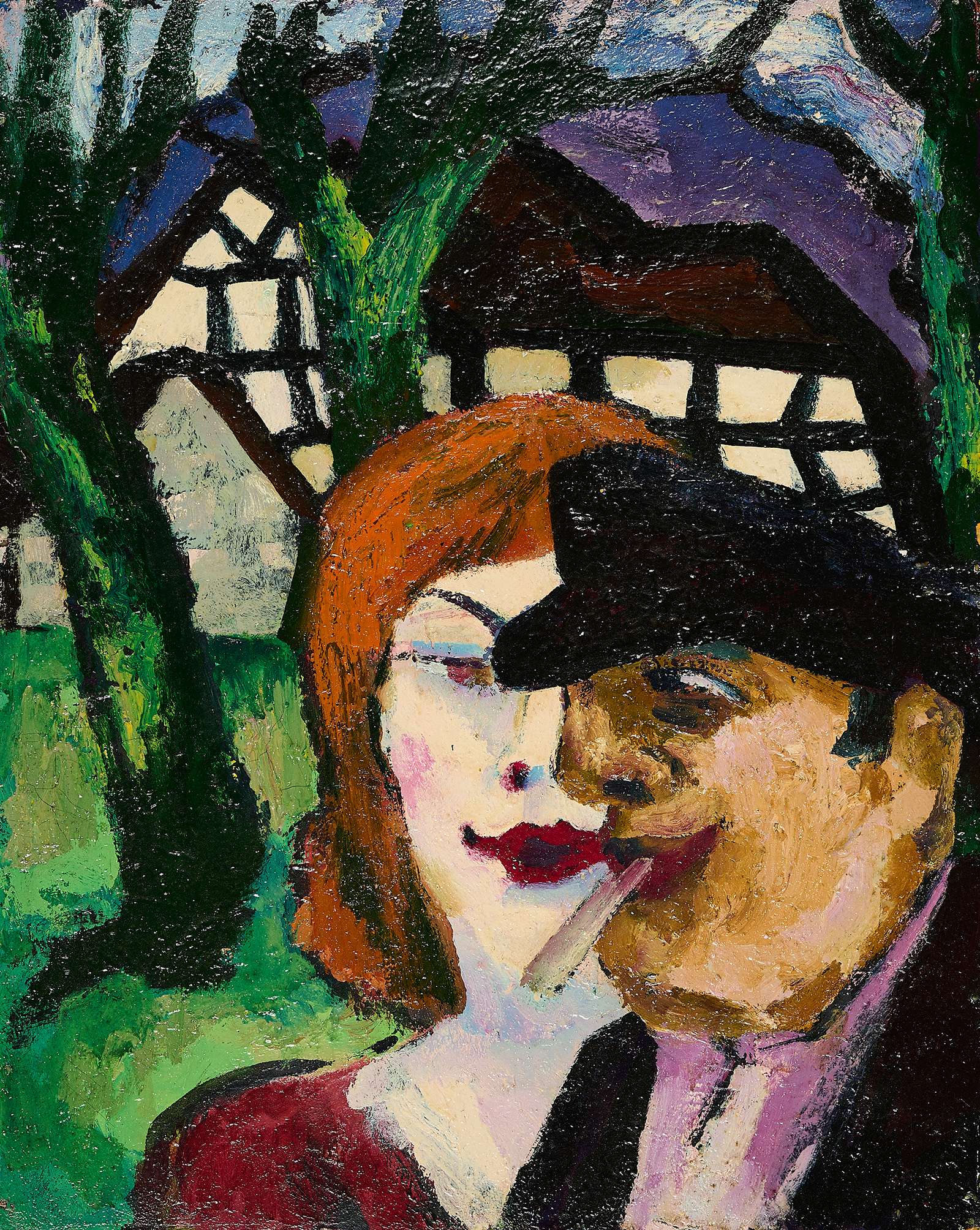
The exhibition explores the fractured biographies of two men: the Expressionist painter and graphic artist Fritz Schaefler (1888-1954) and the Rheinland Jewish industrialist and art collector Joseph Heymann (1887-1954).


Führung
:
Öffentliche Sonntagsführung in der Dauerausstellung
Eine Entdeckungsreise durch unsere Sammlung
Im Zentrum für verfolgte Künste können Sie Künstler:innen entdecken, die über die letzten Jahrzehnte in Vergessenheit geraten sind.
colloquy
:
How could that happen?
Cultural Policy Salon with Götz Aly
Götz Aly is one of the most famous authors on the history of National Socialism and the Holocaust. Cultural Policy Salon at the Center for Persecuted Arts with Andreas Schäfer.



.jpg)